The following design of a perpetuum mobile has been suggested. A capillary of radius r is chosen which allows water to rise to a height h (Fig.).
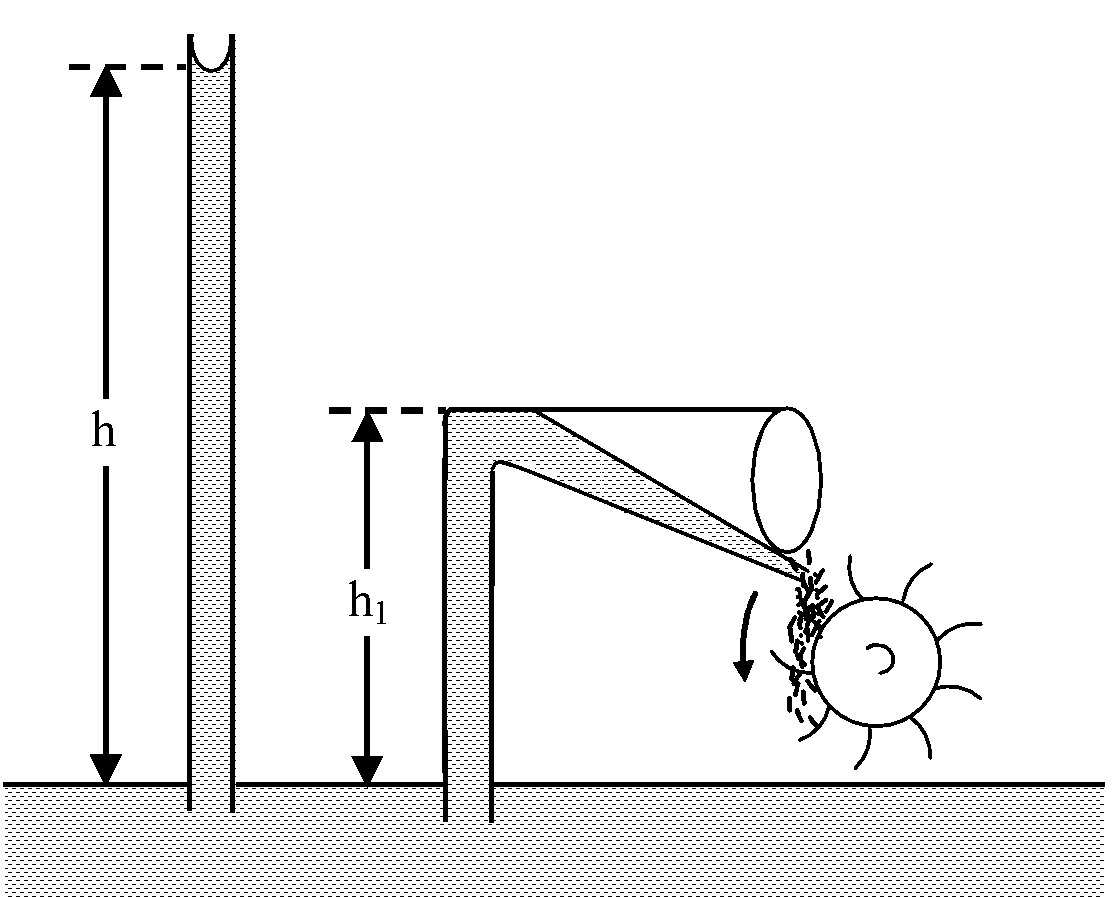
At a height h 1 , smaller than h, the capillary is bent and its upper end is made into a broad funnel as shown in the diagram. The surface tension is enough to raise the liquid to the height h 1 and introduce it into the funnel. The liquid in the broad part of the funnel detaches itself from its upper surface and flows down unimpeded. A water wheel can be installed in the path of the drops falling back into the vessel, thus providing a perpetuum mobile.
Will this perpetuum mobile actually operate? Find the error in the reasoning above.
Text Solution
Verified by ExpertsCHECK THE SOLUTION.
Sol. As soon as the water enters the funnel the radius of curvature of the meniscus will begin to increase and, correspondingly, the surface tension will gradually diminish. The water in the funnel will only reach the section with that radius R where the surface tension exactly equalizes the weight of the water column h.
The radius of this section can be determined from the ratio
2 π R α = π r 2 dgh or R = 
The perpetuum mobile will not operate and the water will not flow out of the funnel.
Prepare Smarter with CGP Edu
Get practice questions, solutions, and test series in one place.
Write a Review
Share your experience with this question and solution.
Commentary
Send your comment, doubt, correction, or feedback to admin.
Similar Questions
Explore conceptually related problems